Hi everybody !
Here we are… a brand new year for Pierre Wildlife with lots of travel projects, new species sightings and much more to come ! 2018 is really going to be exciting ! But before writing about my schedule for this year (this will be in another soon-to-come update), I wanted to open the discussion about a topic that I have been trying to work on for more than 5 years. It deals with mousedeer species identification in captivity and, as the title says, it has proven to be a true headache !
We are going to focus about the genus Tragulus because this is where all the identification trouble has occurred in recent times. What I mean by trouble is identification issues at species level (but also subspecies sometimes) because of the recent split of Tragulus javanicus, the Javan mousedeer, in two species. A few years back, all “Lesser mousedeers” from mainland Asia and greater Sundas were lumped under the name Tragulus javanicus with many subspecies known. Now, Tragulus javanicus is restricted to the island of Java where two color forms are known to occur (their taxonomic status might still be discuted at this time). The lesser mousedeers from Vietnam to Malaysia, Borneo and Sumatra are now listed as Tragulus kanchil (kanchil meaning mousedeer in Malay).
Two other mousedeer species are known to be kept in zoos. The Greater mousedeer (Tragulus napu) with two subspecies found in the main zoos of South East Asia is apparently absent from European collections. I think there are still some specimens in American zoos but this requires confirmation. Subspecies rufulus, recognized by a well distinct black mask around its snout and eyes and its orange-rufous coloration is known from Singapore Zoo and was previously kept in Zoo Melaka (Malaysia). Nominate subspecies, darker brown with very faint mask on face, is still kept in Zoo Melaka and is also known from one or two other Malayan zoos.

Tragulus napu napu from Zoo Melaka. This subspecies is darker brown.
The species itself is much larger than the lesser mousedeer and shows longer
white neck stripes and mottling on back.

The rare Tragulus napu rufulus, endemic to Pulau Tioman (Malaysia) is the same
size as nominate subspecies but has a distinct black mask around eyes and snout
and a much more orange coloration. Those characteristics are well visible here.
The other known species of mousedeer from zoos is the endangered Balabac mousedeer (Tragulus nigricans), endemic to Philippines. In size and coloration, it looks like a very dark version of the Greater mousedeer. The species is more and more represented in Europe and is kept in big numbers in Philippine’s biggest zoo, Avilon Zoo.

With its nearly black back and flanks coloration, the Balabac mousedeer is
impossible to mistake with any other mousedeer species.
So far, we are out of harm’s way as those taxa discussed above are relatively easy to recognize. Now comes the trouble with the Tragulus javanicus / Tragulus kanchil complex. In Europe, all Lesser mousedeers are still identified as Tragulus javanicus but, to me, most if not all Lesser mousedeers in Europe actually are Tragulus kanchil for a few different reasons. First, let’s go back to the latest importation of Lesser mousedeers to Europe, done by Mr Radoslaw Ratajszczak, at this time director of Poznan Nowe Zoo. At the time of the import, the split of Tragulus javanicus wasn’t yet accepted so these mousedeers came to Europe under the accurate identification at the time. The papers were filed under the name Tragulus javanicus so, legally, even if the taxonomy has still changed, they are known as T. javanicus.
From my latest conversation with Mr Ratajszczak (I am fortunate to count him as a friend), it appears that the mousedeers imported to Poznan were originally from Indochina (Thailand most probably). In this case, following the new classification, their scientific name is Tragulus kanchil affinis. The Poznan mousedeers have bred very well and were sent all over Europe in the last decades. It would be interesting to take a look at the mousedeer population today and see if there are any other mousedeers from different imports still alive at this time. Anyways, most of the captive stock in European zoos, if not mixed with possible other populations, should be known as Tragulus kanchil affinis.

One of Europe’s numerous Lesser mousedeers in zoos, this one taken at
Zooparc de Beauval in France.

Tragulus kanchil affinis from Vietnam, kept at Cu Chi Wildlife
rescue center, near Ho Chi Minh City.
From a physical point of view, Tragulus kanchil and Tragulus javanicus are superficially similar but can be told apart by the orange face and greater size of Tragulus javanicus, especially. So far, I have seen true Tragulus javanicus only on Java island, in Gembira Loka Zoo that houses a breeding group and in Batu Secret Zoo (east Java, near Malang) where offsprings from Gembira Loka zoo are kept.
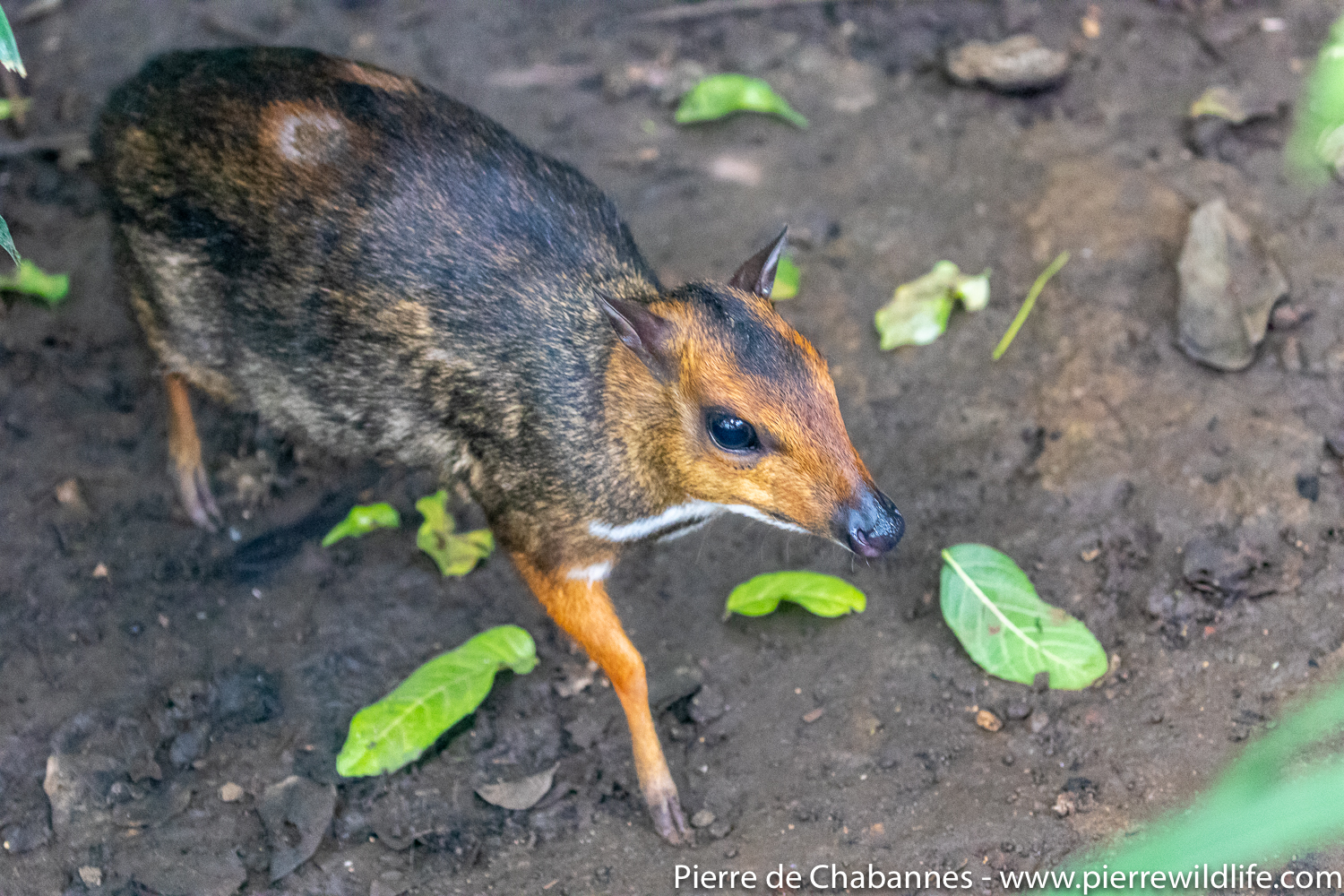
One of the only true Tragulus javanicus I have seen. As you can see on the photo, the orange face is quite obvious and a unique character for this species.
But here is where it becomes even trickier… many animals kept in Javan zoos are actually from Kalimantan (South Borneo) and Sumatra. The case arises with the Javan mousedeers displayed in Ragunan Zoo (Jakarta). These animals are relatively dark but with a different shade of coloration (and what seems to be a slightly longer snout) than the true T. javanicus shown above. I have yet to receive confirmation about this but these mousedeers might actually be Tragulus kanchil from Sumatra, in that case, they would belong to nominate subspecies Tragulus kanchil kanchil.

One of the Javan mousedeers in Ragunan Zoo. The snout doesn’t look as short as in the true T. javanicus and the coat has a completely different coloration, much closer to T. kanchil. Investigation is still going on to find out about their true ID.
In Mainland Asian zoos, we find the same problem as in Europe because most zoos still use the old taxonomy and label their mousedeers as Tragulus javanicus. In all cases I have seen so far, these mousedeers were in fact Tragulus kanchil. In Malayan zoos, things can get more complex because there are two different subspecies in Peninsular Malaysia, fulviventer in the south and ravus in the north. Zoo Melaka keeps the southern population it seems whereas Penang Bird Park and Zoo Negara keep ravus. Zoo Taiping’s population ID is still being investigated.

Penang Bird Park (Malaysia) keeps a very nice breeding
group of Tragulus kanchil ravus.
Most zoos in Thailand, Vietnam and Cambodia keep Tragulus kanchil affinis but there is another possible issue coming up here as there are two very poorly known mousedeer taxa from northern Thailand and Vietnam: Tragulus versicolor (previously treated as a subspecies of T. napu, its presence in the wild is uncomfirmed at the moment) and Tragulus williamsoni (occurring as isolated populations in northern Thailand). So far T. williamsoni is only known from the holotype. It used to be treated as a subspecies of T. kanchil but being significantly bigger than the average mousedeer from the nearby areas (it would be Tragulus kanchil affinis). Although their presence in captivity in Thailand and Vietnam is unlikely, we must not rule out this hypothesis yet as I have seen a very dodgy specimen of Tragulus kanchil in Dusit Zoo (Thailand) back in 2009. At this time, the zoo identified some of their mousedeers are being Tragulus versicolor. I don’t believe this to be accurate but this mousedeer looked bigger than T. kanchil affinis and seems to have a different breast pattern. Is it a weird T. kanchil affinis or could it be T. williamsoni, or a hybrid… or something else… I haven’t managed to solve this problem yet.

My only photo of the dodgy Tragulus from Dusit Zoo in Bangkok, taken on
January 1st 2009. I haven’t seen this specimen on my other visits to this place.
So, as you can see, mousedeer identification in zoos can be quite tricky if the proper data about importation and origin of animals isn’t preserved. This could apply to many other cases because one never knows what could happen to a species with the new scientific discoveries made on a nearly daily basis. Keeping track of the collection and making sure no hybrids are made is, to me, an important part of a modern zoo’s mission.
I hope you will find this article useful ! If you have any question or want to debate, the Photozoo Collection’s facebook page is there for you ! Talk to you soon with another article about my travel schedule for this year ! Some exciting things are going to happen !
Thanks again for your support !
Gratefully yours,
Pierre de Chabannes
Founder, Pierre Wildlife